My disenchantment with institutions
I used to have a baseline level of trust in Canadian institutions to generally tell the truth and act in the best interest of Canada’s citizens. This was eroded away by the COVID response, and completely broken during the trucker protests in Ottawa.
I had happily gotten my vaccine shots when they became available, believing, as I was told, that this was the end of the lockdowns and the start of the return to normal public life. The vaccine passport program was sold to the public under the assumption that the vaccines were going to stop transmission. But the information on the effectiveness of masking, social distancing, lockdowns, and vaccines continued to shift and change, day by day. The more the story shifted, the less I trusted any of it.
I was living in Ottawa at the time of the trucker protests. I was following the story very closely for many reasons. I was tired of how COVID was being handled, the convoy became international news, and life had become much smaller during the lockdowns, so I had less of a personal life to focus on.
I went downtown and walked around a few different times over the weeks after the truckers arrived, wanting to see for myself what was going on. Throughout the protests, there was tons of raw video footage of the protests uploaded onto YouTube that I would watch (like this one, for example). What I was seeing with my own eyes in person and what was uploaded to YouTube did not at all match the way people were talking about the protests. Walking through, it felt like a street festival. People from all backgrounds were playing music, dancing, and cheering.
However, many people I spoke with about the protestors viewed them with much contempt. They saw them as selfish, dangerous troublemakers. People I knew casually suggested the army should be called in. Many were supportive of debanking people who donated to the protests, which I saw as an extreme and antidemocratic measure.
Close to the end of the protests, the heat was cranked up. People who lived downtown were (understandably) exhausted and furious. There was huge pressure on the police to remove the protestors. During this time I had seen video of a woman with a walker saying “This is what we’re doing this for: peace, love, and happiness. We are a peaceful protest” and then getting run over by a police horse (the first clip in this youtube video).
On the day of this incident, the police chief tweeted that a bike had been thrown at a police horse, causing it to trip:
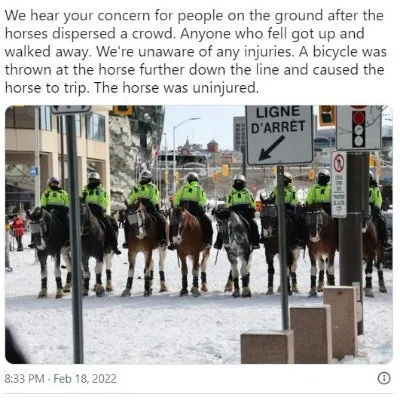
The bicycle assertion was repeated in this article, which included the following section:
“However, rumours on social media quickly sprang up claiming a woman had been trampled by one of the horses — potentially to death.
Interim Ottawa police Chief Steve Bell told reporters on Saturday that protesters are engaging in misinformation during this police action.
"Almost immediately there [were] tweets, there [were] pictures that had been photoshopped, out on social media that indicated people had died," Bell said. "That the horses had run over someone with a walker in the crowd."
He did say that the two people who fell down "immediately got back up and started to engage in their protest and demonstration activity."
Ottawa police say no one was seriously injured by the use of horses. But there remains some question about whether, as police said Friday, a bicycle was thrown at one of them.
When pressed for details that it was indeed a bicycle — there have been reports that it was perhaps a knocked-over wheelchair — Bell said he would have to check.”
Now, thankfully, the woman in the video did not die. But having just seen it happen, I was disturbed that the police chief would say that the story that a woman with a walker had been run over by a horse was fabricated. I was additionally surprised that the reporter who had written the article hadn’t made an attempt to view the videos documenting the events that I had easily accessed on YouTube.
The article was later updated with the information that someone had been reported seriously injured, and the following photo that clearly shows the woman and her walker, not a bicycle or wheelchair.
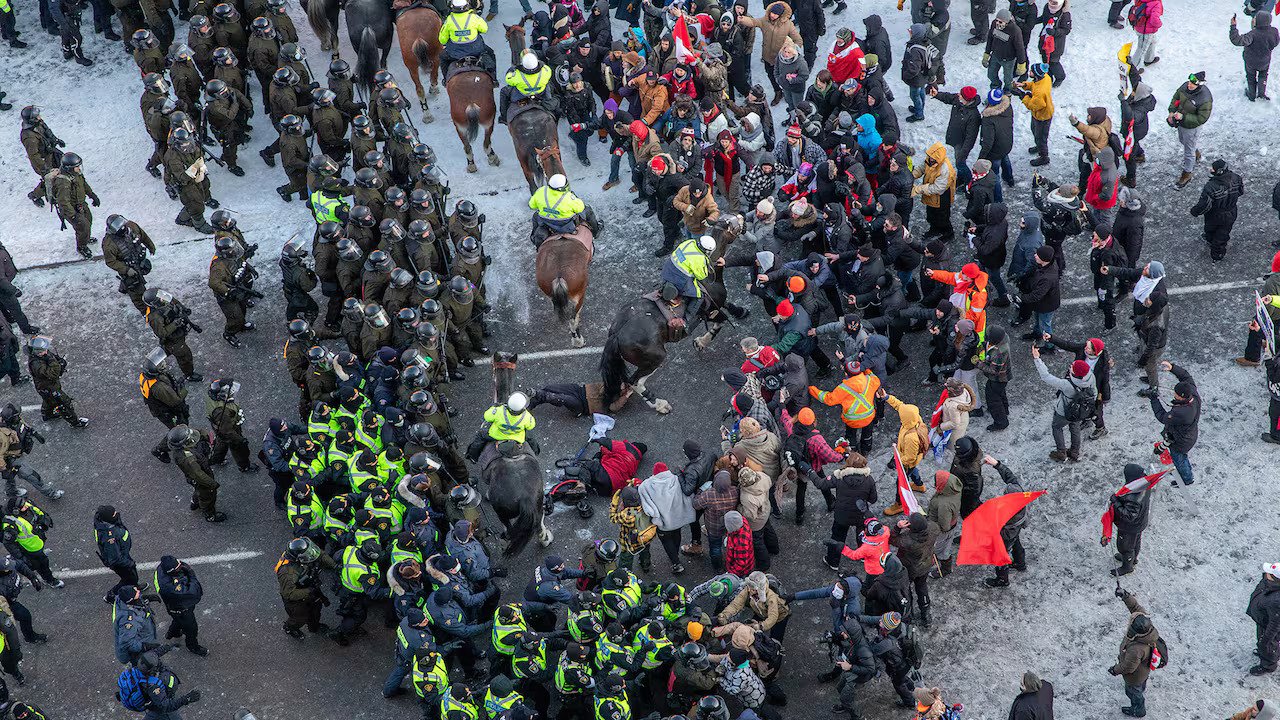
Now, could there have been a separate incident on the same day in which a protestor threw a bike at a horse? Yes, of course. But I could not find any photo or video evidence of that, and it’s not like the events weren't being filmed.
The way the story had been reported and the comments from the police were unsettling to me. But the moment that catalyzed my disenchantment with these institutions was when someone I knew said:
“How can you still support the protestors? They just threw a bike at a police horse!”
It was that moment that I realized that reality had been split on purpose. There was the version of events that had happened in real life and the version of events that had broadcast to the people that were not there and didn’t watch the raw footage. And the second version of events was winning.
Maybe this seems very naive, but that moment broke any good faith I had in Canadian institutions (public health, the police, the media) to at least try and tell the truth. I don’t believe that trust will ever be restored.
A large part of why I decided to write this book is to create a world in which a young person is presented with a series of versions of reality, and show how she navigates them: from first believing whatever she is told, to later becoming more and more discerning. She begins questioning why other characters see things certain ways, and learning how to trust her own internal judgment. I would not have been as motivated to tell this story without my own experience of a split-reality world.